Many people know that LED lights are more energy efficient than CFL, metal halide, and incandescent lights. Are LED lights really more energy efficient? Why are led lights better?
In this article, I will compare the material and characteristic differences between LED lamps and traditional lamps in detail. I will compare and explain the following points.
Characteristics of incandescent lighting and its lighting materials.
Lighting theory of ESL (Energy Saving Lamp).
LED Lamp Components, Lighting Principles, LED Energy Efficiency, Lifetime VS Incandescent Lamp CFL, ESL.
Why do the LED lights you buy die easily and don't save you money?
After reading it all, you'll have your answer and pretty much know how to pick a good LED light for yourself.
 Characteristics of incandescent lighting and its lighting materials.
Traditional incandescent bulbs have a lumen output of about 10 Lm per watt and a lifespan of about 1,000 hours. When the bulb is connected to a power source, current flows through the filament, which then creates a heating effect. As a result, the incandescent filament emits continuous visible and infrared light. This phenomenon occurs only when the filament temperature rises to 700K. Because the filament operates at such high temperatures, most of the energy is absorbed as infrared radiation. Due to the high filament temperature and rapid evaporation, the lifespan is also greatly shortened (so the lifespan of an incandescent lamp is about 1000 hours).
From the perspective of energy saving and consumption reduction, traditional incandescent lamps have large infrared energy loss, large heat generation and short lifespan. Therefore, the development of advanced energy-saving and environmentally friendly lamps is an inevitable revolutionary trend.
Lighting theory of ESL (Energy Saving Lamp).
In contrast, ESL (Energy Saving Lamp) lighting works by heating the filament through a ballast. When the temperature reaches 1160K, the filament starts to emit electrons (because the filament is coated with some electron powder), and the electrons collide inelastically with the argon atoms. Argon atoms collide with mercury atoms to obtain energy. Mercury atoms absorb energy and then ionize to emit 253.7nm ultraviolet light. Because the temperature of the filament is about 1160K, which is much lower than that of incandescent lamps at 2200k-2700k, the service life of fluorescent lamps is greatly improved. The degree of energy saving and consumption reduction can reach 5000 hours. Because it does not have the thermal effect of current incandescent lamps, the energy conversion efficiency of phosphors is also very high, up to 50 per watt.
LED Lamp Components, Lighting Principles, LED Energy Efficiency, Lifetime VS Incandescent Lamp CFL, ESL.
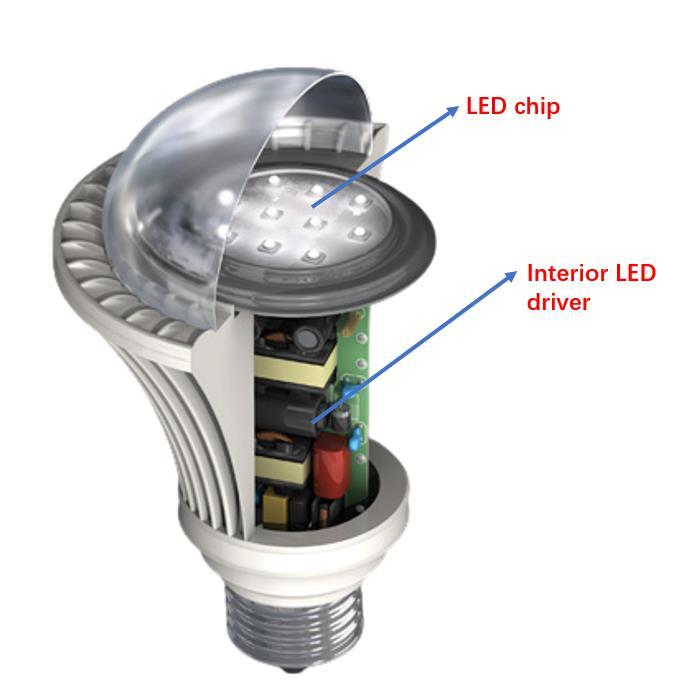
An LED (Light Emitting Diode) is a semiconductor that converts electrical energy into visible light. It changes the principle that incandescent lamps emit light through tungsten filaments and energy-saving lamps emit light through three-color powder, and LEDs use electric field to emit light. Because the LED uses a solid semiconductor chip as the luminescent material, while the main luminescent material of the traditional light bulb is metal, the energy emitted is different. According to relevant statistics, when the red LED reaches a certain brightness, the energy consumption is 15 watts, while the traditional light bulb needs to consume up to 150 watts to achieve the same measurement effect.
According to the analysis, the advantages of LED are very obvious - long life, high luminous efficiency, no radiation, low power consumption. The spectrum of LED is almost concentrated in the visible light band, and its luminous efficiency can exceed 150lm/w (2010). Compared with traditional incandescent lamps, spiral energy-saving lamps and T5 tri-color fluorescent lamps, the results show that the luminous efficiency of ordinary incandescent lamps is 12lm/W, and the lifespan is less than 2000 hours. , T5 fluorescent lamp 96LM/W, lifespan is about 10,000 hours, the luminous efficiency of white LED with a diameter of 5mm can exceed 150lm/W (In Weshine, the real lumen output of finished high-power LED lamps can reach 145lm/W, which is also a Chinese LED lamp company. Top level), the service life of the LED chip can reach more than 100,000 hours (Weshine's LED light span can reach 50,000 hours)). It has also been predicted that in the future, the lifespan of LEDs will be infinite and will dominate the market.
Why do the LED lights you buy die easily and don't save you money?
With the development of the LED industry in the past two decades, the price of LED lights has dropped a lot. Now many car owners use LED lights to decorate their cars, and there are many types of LED lights, bright colors, dimming, and smart.
But there are also some people who lose confidence in LED lights, because the LED lights they buy are usually easy to crash, unlike its energy-saving and 45,000-50,000-hour lifespan. In fact, this is not to blame for LED lamps. It is the production process and materials. The development of the LED industry for many years has made LED lamps from their components, power supplies, LED chips, and heat sinks to low-end materials. .This causes the following quality problems.
1. The cheapest uses a very simple power supply structure, so the LED lamp dies very quickly. If the entire lamp dies in a short period of time, the most common problem that occurs in the driver is that it does not work.
2. Another inferior type is the use of LED chips from small factories. People usually know that LED chips are characterized by super bright, so it can be equivalent to a very high-power traditional lamp with less power, thereby saving a lot of electricity. However, the bright LED chip does not mean that the finished LED lamp can reach high lumens. Before being used for lighting, the LED chip needs a chip packaging process. If there is no good equipment and technology in this step, the lumens from the LED chip will be low.
Therefore, not all LED lights are good. We need to understand some basic principles to help choose the real light efficiency and energy saving of good LED lights.