As the name suggests, fog lights are complementary car lights designed to give you more visibility while driving under poor weather conditions. They are not standard car equipment. In fact, you can drive around many countries without the help of fog lights. But in places where fog and snow are dense, fog lights make your driving safer.
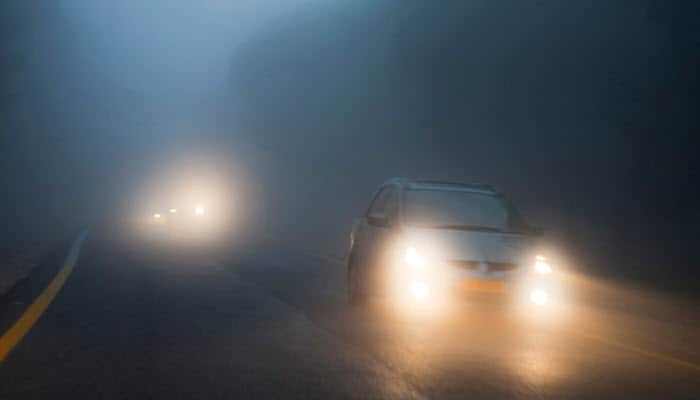
Fog lights have a peculiar beam shape compared to your regular headlights. The shape of their beams is mostly wide and flat (creating a strong bar-shaped beam). They are placed low on the car and close to the front bumper and rear tail. Technically, they are designed to cut through the minute water particles in the atmosphere.
This would improve your road visibility. It is of note that low road visibility attracts road accident because you cannot see incoming obstacles – animals, road curves, signs, trees – in time.
Because distance is a tricky thing when driving under poor road visibility, rear fog lights function as an indicator of distance between cars following each other. It helps other drivers gauge your actual distance and speed.

Because the emitted beam is well-concentrated, it is also strong enough to temporarily “blind” (it dilates your pupil which decreases your ability to see in the dark) other drivers and road users. This is especially the case when it is used without the presence of fog, snow, dust, etcetera. For this reason, some areas prohibit the precarious use of fog lights.
While fog light should be used together with your regular headlight when road visibility drops, it should not be used as a replacement of headlights. Its beam is not broad enough to illuminate larger and distant paths, and it is concentrated enough to kill.
As a rule of thumb, fog lights should be switched on the moment your road visibility drops 100m. For your reference (in case you are not sure when that is), always check if you can still clearly see the rear tail light of the car that in front of you.
If it still visible, driving without a fog light is fine. But if you cannot see their light trail, you should consider using your front and rear fog light. This is important so that you would clearly see what is in front of you and those cars following you would rightly gauge your distance.
Some insurance company today would void your claim when they find out that you did not use your fog light under conditions of poor visibility. Having said that, always turn off your fog light whenever the road visibility gets better. You do not want police officers stopping you due to some road violation.
For the past years, producers have been releasing different types of fog lights with different feats. The three most popular would be the Halogen fog light, HID fog light, and LED fog light.
Probably the most common type of fog light today, this type is usually pre-built in many modern automobiles. They are more accessible and affordable. Its downsides include its shorter life value and its weaker light beam.
This type is a high—intensity discharge (or HID) fog light that uses xenon gas lit by an electrical charge. They last longer due to the absence of filament to burn. They are also relatively efficient and bright compared to halogen types.
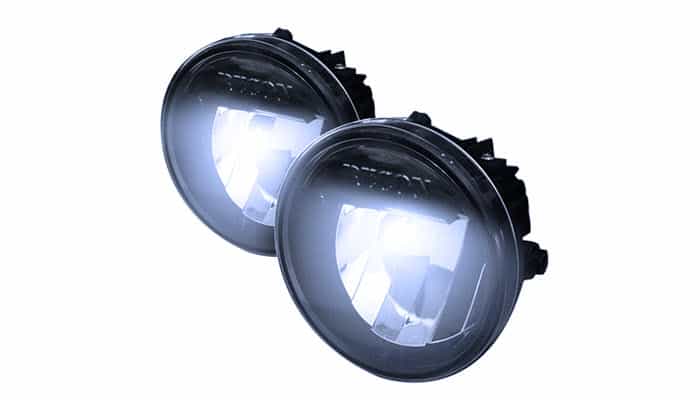
This type is more expensive than the other two. What makes it special is its long life span and energy efficiency rating. This means that you do not need to change your fog light device often. LED fog lights can also be altered to emit different beam colors – giving you more options vis-à-vis different weather conditions.