Driving Lights
Extra lights can serve several functions on a motorcycle.
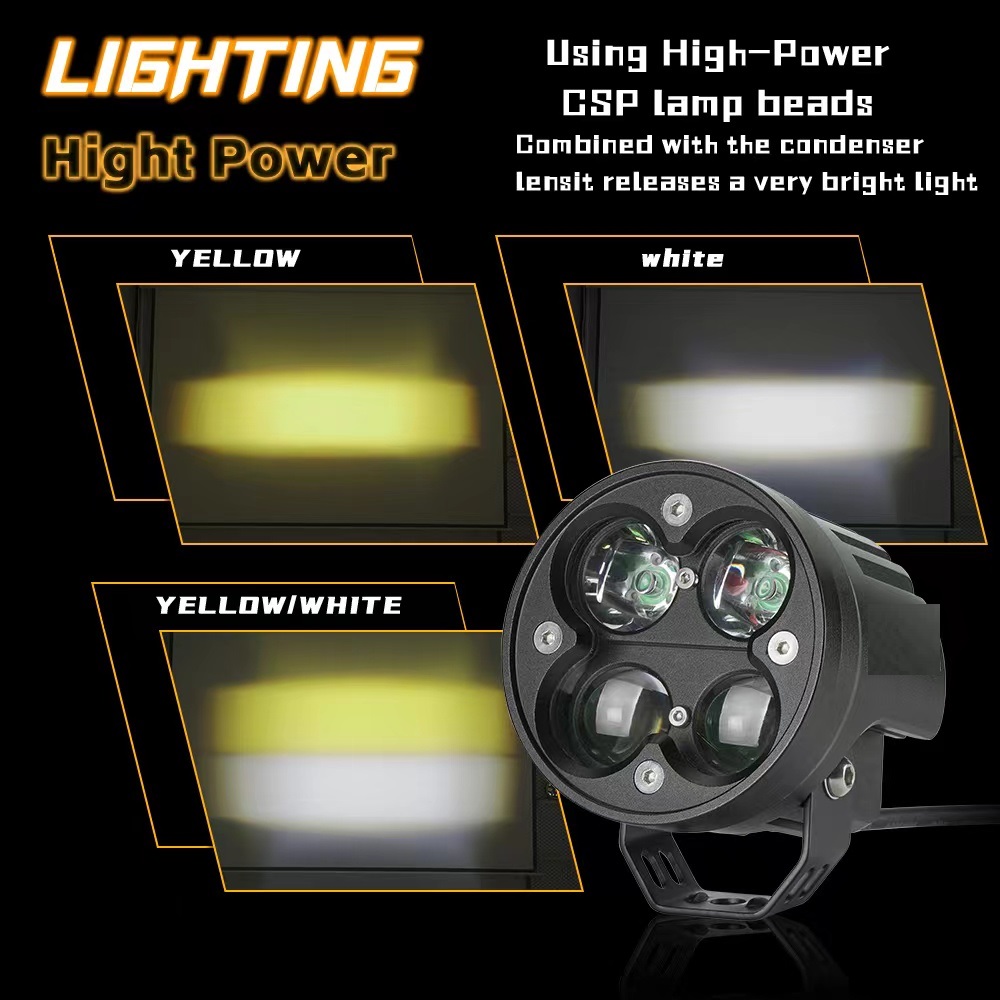
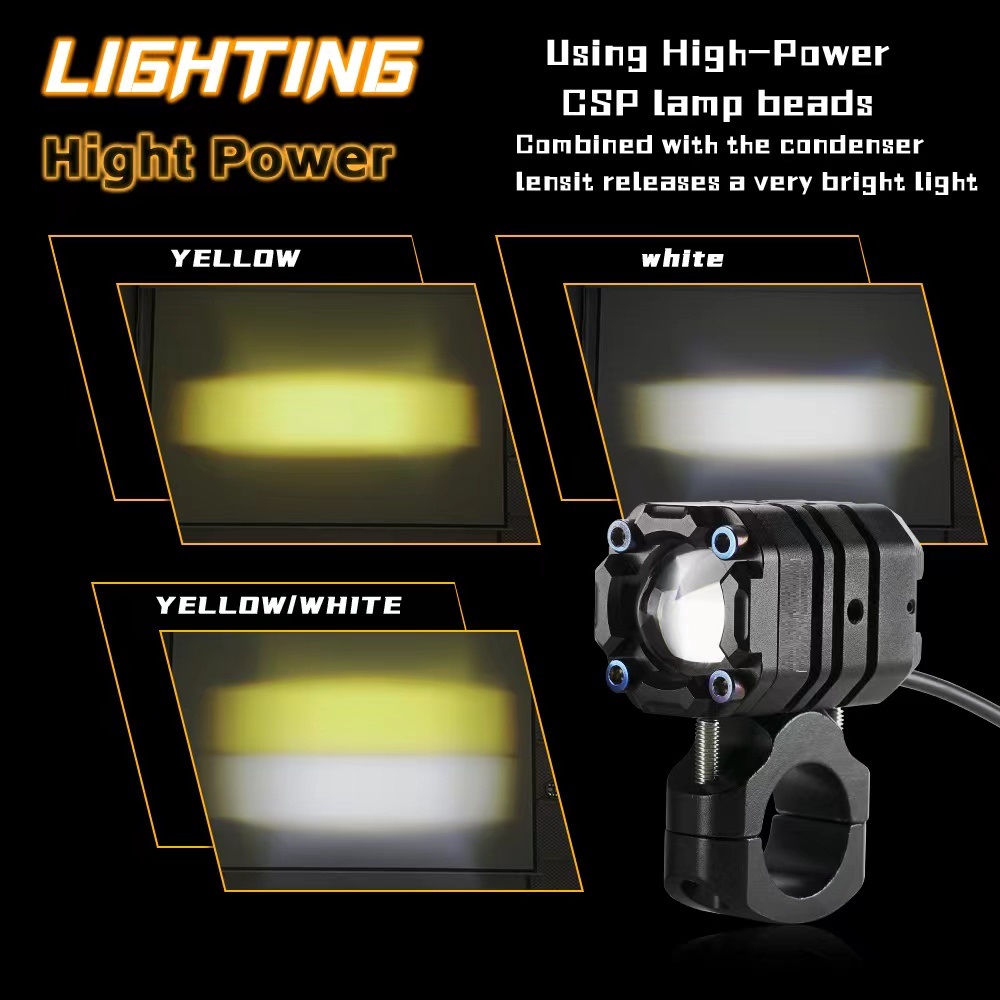
- They can be used as marker lights to increase your visibility to on-coming traffic. A motorcycle with a headlight and a pair of driving lights mounted high or low makes an unusual triangle of light that catches more attention than just a headlight. If this is your primary purpose, color helps catch attention, so you would consider yellow or orange lights.
- Red, orange, and yellow light penetrates fog far better than blue light. This is the same effect as the one which makes the sky appear blue and sunsets appear red. Blue light scatters 16 times as much as red light in atmospheric water, and red light penetrates 16 times as far. Orange or yellow wide-dispersion fog lamps can dramatically increase your range of vision in fog. Red lights would be best for this purpose, but it's illegal (and stupid) to put red lights on the front of your vehicle.
- White lights augment your headlights, giving you extra illumination that adds to your safety margin in very dark places.
- Finally, if you have a lot of lights, you might get invited to participate in parades where cute young girls will wave at you and you can run down your battery and possibly overheat your motor or generator.
Generally, auxiliary lights come in a few different types. Which type you would choose depends on your purpose. Here's what different types of driving lights can do for you:
- Pencil beams are designed to cast a long, narrow beam of light to illuminate straight ahead of you at long distances. Typically the glass in pencil beams is clear with no molded in shaped to disperse the light. These lights can show reflective objects like road signs at distances of up to three miles. These are good for driving at high speed in the desert, or driving at somewhat more sane speeds in normal terrain. They're so-so in the mountains.
- Driving lights are designed to cast a slightly wider beam of light, typically comparable to your high beams. These will illuminate objects at fairly long distances, and also give you a bit of light off the sides of the road. These lights typically have glass which has some molded in shapes to disperse light, and some clear portions. They can show reflective objects at distances of up to a mile. These lights are so-so in the desert, good in normal terrain, and decent in the mountains.
- Wide angle lights are designed to cast a beam which goes forwards only perhaps 100 to 200 feet, but illuminates nearly in a half-circle around your motorcycle. They are good for driving in the mountains at night, as they give you a good view around corners and help you see animals standing on the side of the road, waiting for a chance to run in front of you. The glass on these lights has a large amount of molded in shapes, and essentially no clear regions. These lights are also good for reading street signs when looking for a turn, and for finding parts that just dropped off your buddy's Harley.
- Fog lights are designed much like wide-angle lights, but also have color filters that cut out the green, blue, and violet portions of the spectrum, leaving only the reds and yellows. Blue light scatters almost immediately in fog, producing a blinding glare that prevents you from seeing anything else.
When choosing driving lights, you must also consider how you're going to mount them. The ST1300 fairing is very tight against the various parts of the bike, and not at all structural. You have only a few options:
- Mount them low on the front forks. This is a good position for marker lights and fog lights, but not a good position for driving lights. For marker lights, this makes an unusual triangle shape which catches cagers attention.
- Make a plate of metal to reinforce the fairing area directly above your front fender, and mount very narrow lights there. You must be careful that these lights will not hit your fender when the forks are compressed. If they hit you will certainly damage your bike and possibly lose control of the steering.
- Mount them near the headlight. On the ST1300, you can mount them either above or below your mirrors. This is the best position for white driving lights meant to illuminate the road.
The ideal position for white lights is at your eye level, just behind your eyes. Of course, you're not going to be mounting your driving lights on your helmet, so we must find a suitable compromise. The further away the lights get from eye level, either above or below, the more your lights will cast strange looking shadows that will confuse your depth perception. This is a much more serious problem off road than on road, but even on the road it is something you should think about.
The ideal position for fog lights is low, about a foot or so off the road. The low mounting position minimizes direct reflection of light back into your eyes, so you get the least possible glare.
In this section I list some mounting options first, and some light options second.